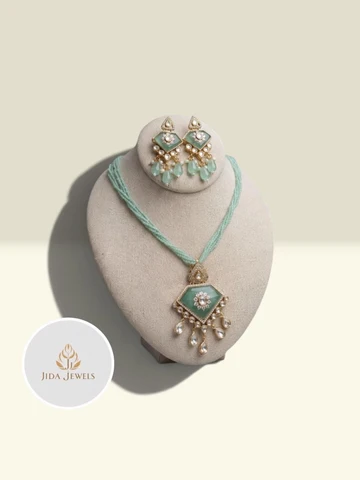

Earrings in India are older than most written records. Sculptures, temple carvings, and buried treasure all show people wearing them thousands of years ago. The history of Indian earrings is also a story about skill, since every era added new shapes, metals, and methods. This guide walks through where these ornaments began, how the designs changed, and why they still matter.
Where the History of Indian Earrings Begins
Ear ornaments appear very early in South Asia. Excavations at Indus Valley sites have turned up beads, shell pieces, and gold items that were likely worn as jewelry. Ancient sculptures at Sanchi and Mathura show men and women with large, heavy ear ornaments.
Buddha statues are a useful clue too. They show long, stretched earlobes, which many scholars link to the weight of earrings worn before he gave up royal life.
Ear piercing also has ritual roots. In Hindu tradition, the karnavedha ceremony marks the piercing of a child’s ears. It is counted among the traditional life-cycle rites.
Origin of Jhumka Earrings
The origin of jhumka earrings is debated. Many historians point to South Indian temple jewelry, where bell-shaped ornaments appear on deity figures and dancers. Others say the Mughal courts helped spread the style across the north.
The name itself offers a hint. In Hindi, the verb jhumna means to sway. That is exactly what a jhumka does. The dome sits against the ear, and the hanging drop moves with every turn of the head.
Because the shape is so simple, it traveled well. Each region added its own touches, such as tiny bells, pearl strands, or layers of domes.
Traditional Indian Earring Designs
Traditional Indian earring designs go well beyond the jhumka. The chandbali, with its crescent-moon shape, is often tied to Mughal-era taste. The bali is a plain or decorated hoop. The kundal is an ancient form mentioned in old Sanskrit texts.
In Maharashtra, the bugadi is worn along the upper ear. It is usually set with pearls and traditionally worn by married women. In the south, temple-style studs use bold gold work and small gemstones.
Each design suited its setting. Heavy ones were for weddings and festivals. Light ones were for daily wear.
Today, a pair of jhumka earrings still follows the old dome-and-drop pattern, though makers now offer it in lighter metals and smaller sizes for modern use.
Types of Indian Earrings
The types of Indian earrings can be grouped by how they sit on the ear. Studs sit flat on the lobe. Drops and jhumkas hang below it. Hoops circle through the lobe. Ear cuffs and climbers follow the curve of the outer ear.
Heavy pieces need extra support. That is why many large earrings come with a kaan chain, sometimes called a sahara. It is a thin chain that runs from the earring up to the hair. It carries part of the weight so the earlobe does not strain.
Size, weight, and shape often show the occasion. A small stud suits an office. A large chandbali suits a wedding.
Indian Jewelry Craftsmanship
Indian jewelry craftsmanship has long been a family trade. A goldsmith, called a sonar, often learned the work from a parent and passed it on. Skills were split across many hands. One person drew the design. Another shaped the metal. A third set the stones. A fourth polished the finished piece.
This shared effort explains the detail in older work. Tiny leaves, petals, and birds sit side by side on a single earring. Each one was shaped and placed by hand.
Many workshops still follow this model. Cities like Jaipur, Hyderabad, and Kolkata have long-standing artisan quarters where such work continues.
Traditional Jewelry Making Techniques
Traditional jewelry making techniques cover a wide range. Goldsmiths hammer thin sheets into shape, a method often called repoussé. They twist fine wire into lace-like patterns, known as filigree. They also place tiny gold beads in careful rows, called granulation.
Enameling is another major method. In meenakari, colored enamel fills small hollows in the metal. The result is bright patterns on the back or face of the piece.
Then there is Kundan, one of the best-known setting styles. Kundan jewelry uses a thin strip of pure gold foil to hold a stone in place, with lac as a base. The stone is pressed in and the foil is shaped around it. The result is a smooth, glowing setting that has been used in royal courts for centuries.
Cultural Significance of Indian Jewelry
The cultural significance of Indian jewelry goes beyond looks. Ornaments mark milestones such as birth, marriage, and festivals. They are passed from mothers to daughters. They are also seen as a form of savings, since gold holds its value over time.
Earrings carry their own meaning. In many families, a child’s first pair is a gift from relatives after the piercing ceremony. At weddings, brides often wear earrings that have been in the family for generations.
Regional styles add more layers. A bride in Rajasthan may wear heavy gold and Kundan. A bride in Tamil Nadu may choose temple gold. Each choice points to a home, a community, and a past.
Why the History of Indian Earrings Still Matters
The history of Indian earrings shows how a simple object can hold so much. A hoop or a bell shape started as a practical ornament and grew into a record of skill and belief.
When you look at a pair today, you can often read part of that story. The dome shape points south. The crescent points to the courts. The setting method points to a workshop tradition. Knowing this helps you choose pieces with care, and it helps you value the hands that made them.